
Control rooms designed for 24x7 —
built in Bengaluru, supported on the ground.
Planar fine-pitch LED, Drita and Seada controllers, Jupiter processors and Seada matrix switching — engineered for NOCs, command centres and surveillance walls.
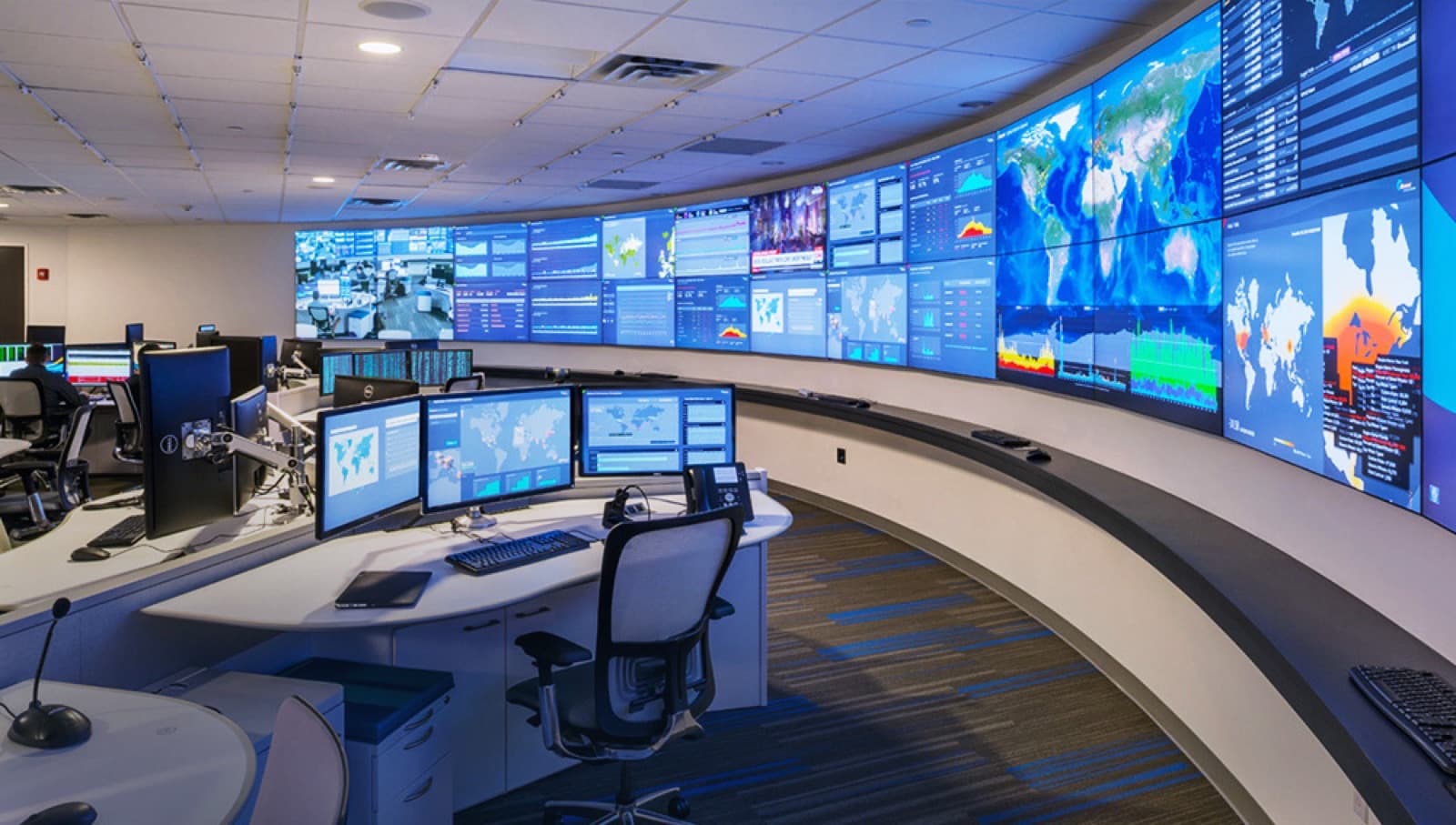
Failure has operational, not aesthetic, consequences.
24x7 demands real redundancy
Redundant power, hot-swap fans, RAID storage and burn-in mitigation — table stakes, not options.
Many sources, not just an HDMI input
Operators need IP streams, RTSP cameras, dashboards and KVMs on screen at once — not one source at a time.
Pitch follows operator distance
Pixel pitch must match operator viewing distance; over-spec wastes budget, under-spec costs readability.
Vendor accountability matters
When a NOC wall blanks, you need a single accountable team — not OEM and integrator pointing fingers.
The layered control-room stack.
- LED canvas
Planar PFI series (0.9 / 1.2 / 1.5 / 1.8 / 2.5 mm) with dual power and receive-card redundancy and front + rear maintenance; Planar VDS series (0.78 / 0.935 / 1.25 / 1.56 / 1.875 mm) full flip-chip COB where contrast and durability are paramount.
- Video wall controllers
Drita DT4000 Windows controllers (up to 12 4K outputs, 64 FHD, redundant PSU, RAID-1) for general NOCs; Drita DT4000 FPGA multi-screen controllers (up to 64 HD or 32 4K capture, BIS / ISO / NSIC certified) for virus-free 24x7 ops; Seada SolarWall Micro (FPGA Crossbar, 8 HDMI in, up to 16 HDMI out) for compact control rooms; Jupiter Catalyst V for premium command centres needing 16 4K direct inputs and 120+ H.264 stream decode.
- Matrix switching and distribution
Seada G44-HDMI for 4-in / 4-out 4K@60 4:4:4 routing.
- Operator desks and ancillary displays
LG UL5Q UHD signage for satellite displays and dashboards.
Nine steps to a live NOC.
- 01Operations interview
What is being monitored, how many operators, shift patterns.
- 02Source audit
How many IP cameras, RTSP feeds, dashboards, KVM sources.
- 03Pixel-pitch and canvas sizing
Against viewing distance to closest operator.
- 04Controller architecture
Windows vs FPGA, redundancy strategy.
- 05BoQ + reference architecture
Source layer → controller → distribution → canvas, documented.
- 06Civil and electrical coordination
Load, cooling, cable routes.
- 07Phased install
Parallel testing of controller and canvas.
- 08Acceptance testing
Against source matrix and failover scenarios.
- 09Handover with runbook + AMC
Documented escalation path and committed response targets.
Specialist depth, in your city.
- Specialist depth — rare in Bengaluru
Planar fine-pitch + Drita / Seada / Jupiter controllers under one roof — most integrators do one of those, not all.
- Bengaluru-rooted AMC
Rapid local response from our Nagarabhavi team for mission-critical sites — not a remote SLA from another metro.
- Vendor-neutral architecture
We recommend Windows or FPGA controllers based on your security and uptime posture, not on what we have in the warehouse.
The short answers.
LED video walls
Planar PFI and VDS — the canvas behind every NOC we build.
Video wall controllers
Drita DT4000, Jupiter Catalyst V, Seada SolarWall.
Planar — brand page
Why we lead with Planar for indoor fine-pitch.
Seada — brand page
FPGA Crossbar controllers and matrix switchers.
Drita — brand page
DT4000 Windows + FPGA controllers, BIS / ISO / NSIC certified.
AMC service
24x7 AMC tiers with onsite response targets.
Mission-critical AV deserves a
Bengaluru-local partner. Let us walk your site.
Send us a brief — operators, sources, viewing distance and uptime tier. We come back with a reference architecture and a starting BoQ within one working day.